Before workers enter a tank for cleaning, the site and cleaning contractor need to agree why entry is necessary, which parts of the installation will be isolated, who controls access, how the tank atmosphere and working conditions will be assessed, and what emergency arrangements are required. They also need a common understanding of the cleaning task and the condition expected afterwards.
These decisions are not established by simply emptying the vessel or opening its manway. They depend on the actual installation, previous contents, connections and work being undertaken.
For a maintenance or facilities manager commissioning the work, the priority is to define the responsibilities and information needed before the entry activity is authorised.
Establish why personnel need to enter
The starting point is the work that cannot be completed satisfactorily from outside. This may involve deposits behind equipment, inaccessible surfaces or a particular cleaning finish that a proposed external method cannot achieve.
According to the Health and Safety Executive’s explanation of the Confined Spaces Regulations, entry should be avoided where possible. When it cannot be avoided, the work needs a safe system and suitable emergency arrangements.
The buyer therefore needs to understand the practical reason for entry rather than treating internal access as the default method. A clearly defined cleaning objective makes that decision easier.
For example, removing loose material from an accessible floor may present a different problem from clearing a hardened deposit behind internal supports. The required finish, internal geometry and available openings determine what remains to be done.
Where tank entry is necessary, we can discuss the layout, retained deposits and required cleaning result as part of a confined space tank cleaning enquiry.
Who provides the information about the tank?
The site controlling the installation normally holds much of the information needed to understand how the tank operates. The cleaning contractor needs accurate details of the vessel and its connections to develop the proposed working arrangements.
Useful information includes:
- The tank identification, capacity, layout and access openings.
- Current and previous contents, including known changes of product.
- Available safety information about stored substances and residues.
- Connected pumps, valves, pipework, agitators and other equipment.
- Existing drawings, inspection findings and relevant maintenance records.
- The required cleaning result and any following inspection or repair.
Records should be checked against the actual installation where their accuracy is uncertain. A drawing can identify a connection, but it does not independently establish whether that connection has been isolated or emptied.
The site’s operating knowledge is especially important where several tanks share pipelines or where equipment has been modified over time.
Agree the isolation boundary before scheduling entry
A tank may appear empty while still being connected to equipment that can introduce liquid, vapour or mechanical movement. The isolation boundary identifies the equipment and connections that must be controlled for the planned activity.
Depending on the installation, this may include supply and return lines, gravity feeds, transfer pumps, heaters, electrical equipment and moving internal machinery.
The HSE’s confined-space guidance, INDG258, discusses isolation, atmosphere assessment, ventilation and safe working arrangements as parts of the overall preparation.
It is useful to distinguish three responsibilities:
- Identifying the boundary: establishing the connected equipment and sections of the installation relevant to the work.
- Implementing isolation: applying the controls required by the assessed work method and verifying their effectiveness.
- Controlling changes: ensuring the arrangements remain in place while cleaning proceeds and are only altered through the agreed authority.
The precise isolation arrangement belongs to the task-specific assessment. A general statement that the tank is out of service does not explain which connections and energy sources have been addressed.
Agree access, atmosphere assessment and site coordination
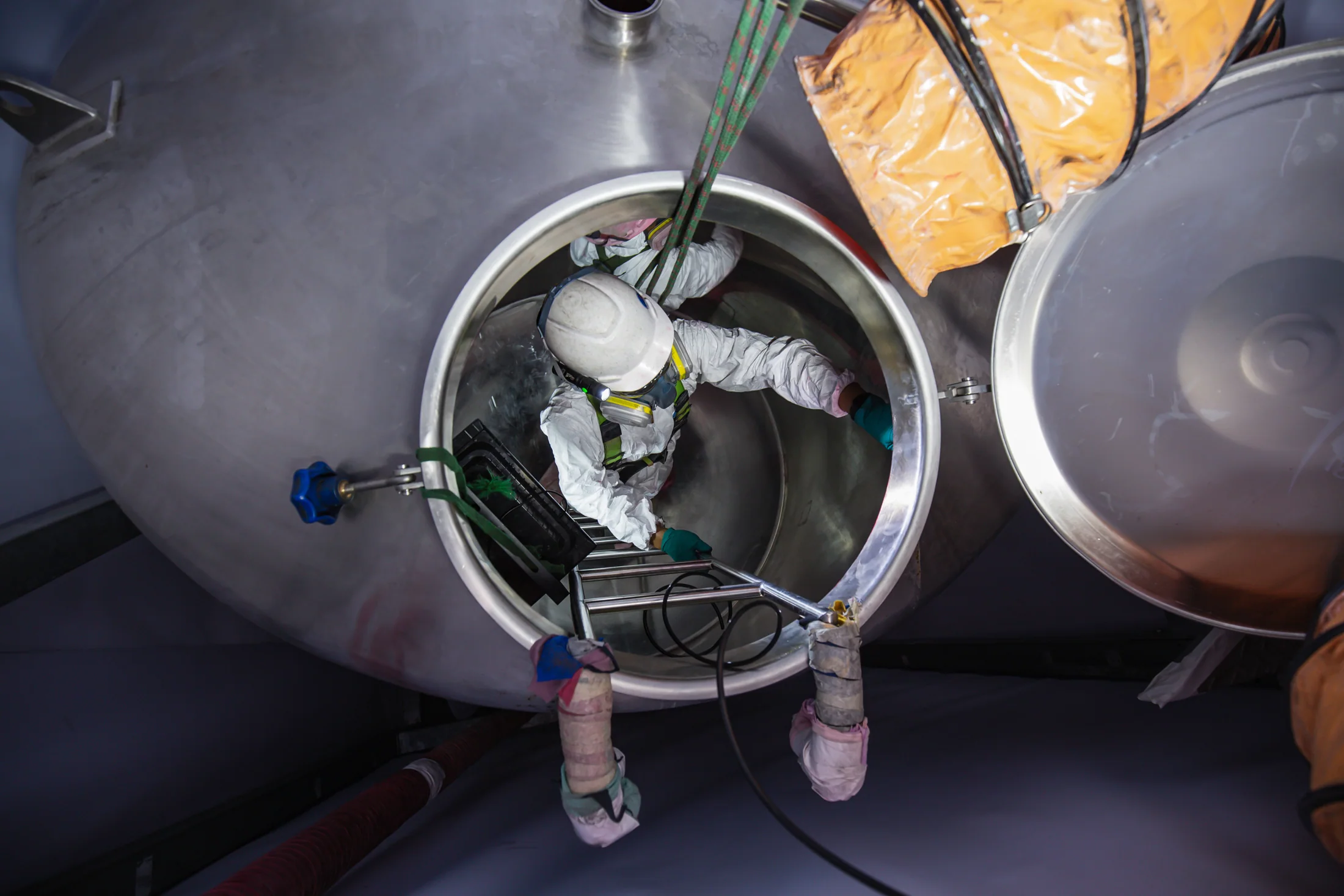
Internal access requires more than a suitable opening. The arrangement has to account for the number of people involved, entry and exit routes, equipment movement, communication and the space available around the tank.
Working conditions also need to be understood. The nature of the previous contents, possible oxygen deficiency, vapours and changes caused by the proposed cleaning activity can affect the assessment.
HSE explains that a confined space is defined by its enclosure and foreseeable specified risks, not by tank size alone. The conditions also need to be considered for the particular task rather than inferred from a previous entry.
Who has authority over the working area?
The site and contractor should identify who controls the plant, who confirms the required isolation, who authorises entry under the applicable arrangements and who coordinates other work in the vicinity.
This matters when adjacent maintenance, product transfer or production activities could affect the same equipment. Shared access routes can also influence how the work is scheduled.
An agreement about responsibilities should identify the people or roles involved, rather than assume every part of the preparation belongs to the cleaning team.
How should rescue arrangements affect the appointment?
Emergency provision must be established before entry and must suit the space, access route and work. It is not enough to assume that calling the public emergency services provides the complete arrangement.
The HSE’s Approved Code of Practice L101 explains that emergency arrangements need to be suitable for the foreseeable incidents and include appropriate provision for rescuing people from the space.
For a buyer, the procurement question is whether the proposed working arrangement identifies how emergency provision will be organised and who is responsible for it.
The answer may be influenced by manway location, restricted extraction routes, the working position within the tank and the nature of equipment used. A straightforward entry opening does not necessarily make recovery from every internal position straightforward.
These considerations belong in the planning discussion before a date is confirmed, not as an assumption left to be resolved when personnel arrive.
What cleaning result should be specified?
Even after entry arrangements are defined, the work needs a clear acceptance objective. The contractor and site should establish which surfaces, deposits and internal components are within scope.
A tank may contain baffles, coils, supports and local recesses requiring different levels of cleaning. Our flat-bottom tank cleaning guidance explains how floor levels and low points can influence retained material.
Identify whether the work is intended to remove loose sludge, prepare defined surfaces for inspection or meet a specified condition for subsequent use. These outcomes are not interchangeable.
Any areas that cannot be reached or inspected should be distinguishable from areas where the agreed work has been completed. Separate structural inspection or product-quality requirements should also remain identifiable.
What should be settled before booking?
A useful final discussion brings together the scope and site arrangements:
- Why entry is required for the specified cleaning result.
- Who supplies vessel information and verifies the installed configuration.
- Who controls plant isolation and authorisation of entry.
- How access, communication and emergency provision will be arranged.
- Which areas require cleaning and how completion will be assessed.
- Whether other maintenance or inspection activities share the same shutdown.
These details help establish whether the proposed work is adequately defined and when the tank can genuinely be made available.
For a discussion of the tank layout, residue and entry requirements, get a quote for confined space tank cleaning using the information available about the installation.