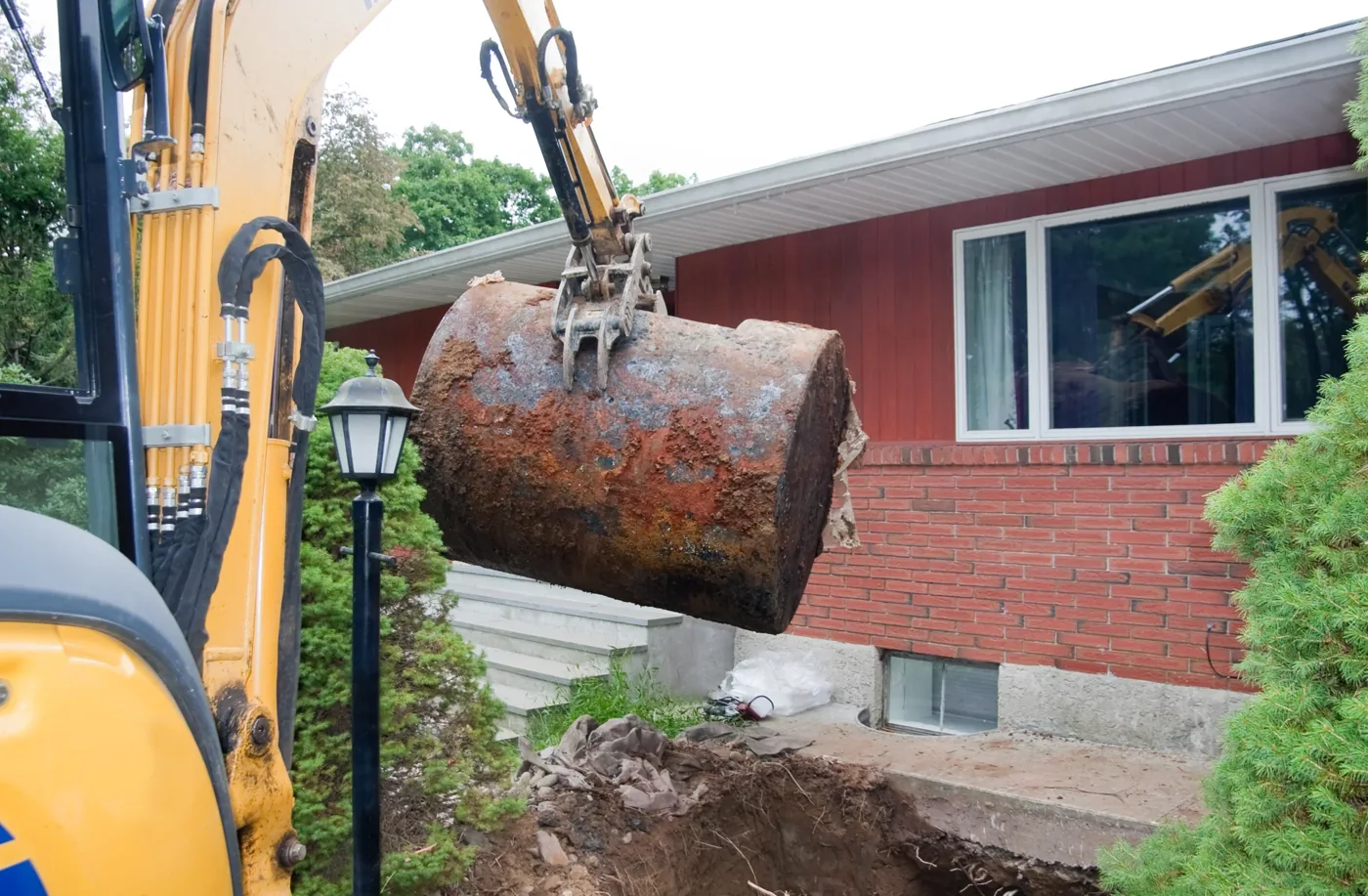
A redundant underground fuel tank should generally be removed where this can be done safely and practicably, particularly if it will not be used again. Permanent closure in place may be an alternative in suitable circumstances, but it is not simply a matter of emptying the vessel and abandoning it underground.
For sites in England, the Environment Agency’s approach favours removing tanks and associated pipework that are unlikely to be reused. Permanent retention requires the agency to be satisfied that the tank presents no risk of soil or groundwater pollution.
What physical removal changes
Removal eliminates the redundant vessel from the ground and creates the opportunity to inspect its former position. The project involves more than lifting out a buried container. Residual contents and connected equipment must be addressed, and the tank must be made safe before excavation and removal work proceeds.
The practical extent of the work depends on tank dimensions, burial depth, surrounding structures and the accessibility of the site. Associated pipework, fill points and dispensers may also form part of the retirement scope.
Physical removal can be particularly relevant where a site is being redeveloped and the former tank position conflicts with proposed foundations, drainage or other construction.
It does not, however, establish that the surrounding ground is uncontaminated. That conclusion requires separate evidence.
What closing a tank in situ means
In-situ closure leaves the tank underground after it has been appropriately decommissioned and made safe. It may be considered where excavation would be particularly disruptive or where the retained structure can be accommodated within the site’s future use.
The Environment Agency’s underground tank decommissioning guidance addresses permanent retention. Where a tank is to remain, it must first be made safe and inerted. The guidance identifies sand and cement slurry, hydrophobic foam and foamed concrete as filling options. Records should identify the tank’s capacity, former contents, decommissioning method and date. Permanent retention also depends on the relevant environmental regulator being satisfied that there will be no risk of soil or groundwater pollution.
Leaving a tank underground does not eliminate its historical significance. Future property works may encounter the structure, and the site owner needs reliable documentation of its location and treatment.
Importantly, in-situ closure is not automatically acceptable merely because removal is inconvenient. The environmental risk and the relevant regulator’s position must inform the decision.
Ground conditions and excavation access
The choice between removal and retention is influenced by two different sets of questions: whether the structure can be extracted, and whether its previous use has affected the ground.
Physical site constraints
Excavation access may be restricted by buildings, services, neighbouring boundaries or operational areas. Underground utilities and structural relationships can affect the excavation design and working area.
These conditions can make a removal project more complex than the tank’s dimensions suggest. They should be considered before assuming that the vessel can be lifted through the available space.
Soil and groundwater
A tank can appear sound while historical releases have affected surrounding soil. Equally, the discovery of an old tank does not by itself prove contamination.
Environmental assessment should distinguish evidence of a release from assumptions based on age or appearance. Groundwater conditions and nearby sensitive receptors influence the significance of any contamination found.
The Environment Agency advises assessment and soil and groundwater sampling as part of decommissioning. Where contamination is identified, further investigation and remedial decisions may be necessary.
Choosing the appropriate project scope
For commercial property owners, a useful starting point is to establish what the project must deliver:
- Permanent physical clearance: The tank and agreed associated equipment need to be removed from the site.
- Permanent closure in place: Retention is being considered and its environmental acceptability must be established.
- Ground condition assessment: Evidence is needed about possible historical releases, regardless of the chosen tank treatment.
These are related decisions, not interchangeable services. The wider tank decommissioning scope concerns retiring storage, whereas underground tank removal includes the physical excavation and lifting requirements.
For redevelopment projects, the programme should also account for the point at which excavation findings may change the groundworks scope.
Separating vessel retirement from investigation of the surrounding ground gives the owner a clearer understanding of what will be removed, what may remain and what environmental questions still require evidence.